Sunday, February 2, 2014

They call my friend ...bhagavan

That is what Villacheri Mani Iyer would have told.  He was a classmate of Ramana Maharishi. It made me wonder...what kind of internal struggle would have been in the hearts of people who have friends/acquaintances of mahaans. Of course, this is just my reflection.

So, going back to the story (as quoted from tattvaloka, January 2014 edition), Mani Iyer often joked to people that he would get Ramana Maharishi back to his worldly life. I can imagine. Often, when such rishis are in our midst, we tend to dismiss their spiritual ascent. After all, they seem like us. The live, talk and walk like us, why they are in our midst. After several years, mani iyer's mother visited arunachala to see bhagavan.  Mani Iyer thought he would visit his friend and also get his mother back. Those days, Bhagavan used to stay in virupaksha cave.

So, the scene shifts to the first encounter of bhagavan and mani Iyer in the cave. Now, something profound must have happened. Mani Iyer prostrated before the bhagavan and his heart did not let him leave the place. So, what would have been the state of mani iyer's heart. He must have thought, "the bhagavan is just his old classmate. He was not accomplished in the worldy sense. He did not have any money. He lived in a cave. He dressed in a kaupeenam. The world calls him a mahaan. He seems to have a glow about him. He seems to have a sense of calm that is unseen among worldly accomplished people. But, he is the same person whom I went to school with? How did he achieve this?"

Now, once this thought is transcended, he would have thought,"now, what do I do? I have 2 choices. I let go of my worldly life and ask my friend to help me experience the same spiritual grace. But, how can I be sure. Maybe all this is just a hoax. Can I let go of my worldly assets to pursue something, that I really do not comprehend? What if I end up a the wrong end of the bargain? I make no spiritual progress and I also lose my worldly assets?  But then, here is my friend, whom the world calls bhagavan..maybe is the best person to help me make any spiritual progress? Will I get another chance? What if this was the best chance for me to make any spiritual progress" 

Letting go is always tough. The world is ever so enticing. When confronted with such profound choices, it must be really tough. So, mani Iyer postponed his trip by a month. I presume each day, these feelings must he tugging his heart. After a month, on day he prostrated before the bhagavan and cried, "please save me". Bhagwan said , "vidu vidu, siva sivanu iru (leave leave, keep chanting siva siva). Mani Iyer took this as his mantra deems has and spent the rest of his life chanting the holy name of lord shiva.

Now, back to the question, how would one have reacted if he/she had been in mani iyer's place? Firstly, I believe that mahaans are all around us in their subtle forms. They are ever compassionate and would understand the pain of worldly followers. A newborn baby cries when it is hungry. It does not have to explain the pain to its mother. A mother knows the pain and feeds thaw child. I believe that mahaans also know the pain that their children face in the world. Hence, at right time, they will feed spiritual knowledge after hearing the cried of their spiritual children. All we can pray is, let my intelligence create the craving for spiritual progress. Let my hunger increase :)


Sunday, February 10, 2013

Kamala Nayana? Why?

It was an interesting week on upanyasams :) The upanyasakar was talking about Kamala Nayana (soulfully rendered by O.S Arun), one of Bhadrachala Ramadas' wonderful kritis . There were some nice attributes of the Lord that were expounded by the upanyasakar from the song. They are worth mentioning.

Firstly, why Kamala Nayana? Why did the poet not use any other flower as a tribute to the lovely eyes of the Lord? First explanation is from the Ramayana, during the incident when Rishi Vishwamitra asks Dasaratha to allow Lord Rama and Lord Lakshamana to come with him :) Here, King Dasharatha deftly mentions his beloved son as "Rajeeva Lochana" to his advantage. He hints to Rishi Vishwamitra, that he young boy's has eyes like the lotus, which blooms during the day and rests at night. He is tender and not exposed to violent ways of Rakshasas, who operate by the night. Dasharatha thus argues that it is not proper for Lord Vishwamimtra to ask such a tender boy to protect the ashram from asuras.

There is another interesting observation. Lord Vishwamitra argues his way with Lord Dasharatha, and then takes Lord Rama and Lord Lakshamana along. The princes are fatigued after such a long and arduous journey. They fall asleep in the forest. Lord Rama is most charming even when is he is sleeping. Think of the Lord who is the personification of Lavayam and Soundaryam. How beautiful would the lord have been in his yoga nidra :) Now, Vishwamitra wants to wake the young children from their blissful sleep. How many of us have the divine fortune to see Lord Rama and Lord lakshamana in yoga nidra? (absolute bliss) Who would have the heart to wake such wonderful children from their sleep? So, he addresses them with suprabatham and then he addresses Lord Rama as "uthista kamala kantha" (wake up, O lotus eyed one) :) I am sure, he must have realized how right Dasharatha was, when he addressed his son as Kamala kantha :)

Secondly,  there are so may flowers like Sunflower (Supatra, Varada in Samskrit). Why did the poet not use these names in this context? After all, the Lord was from Surya Kula, he could have pick sun flower in this context. The upanyasakar had a wonderful observation. The Lord's eyes are brimming with Karuna for his devotees. Hence, the poet wanted a flower that grows on water and conceals the water, just like his eyes are representation of the Karuna that wells in his heart from the bhakatas. Hence, the flowers that grow on land are no good :)


Another section of this poem, the poet uses the word "Kama janaka" for Maha Vishnu? How is this relevant? The upanyasakar has 2 wonderful observations on this  !!

Firstly, Kama is the source of all desires and represents all things beautiful :) So, if Lord Krishna is addressed as Kama Janaka, or father of Kama, how beautiful must the Lord be :) After all, Lord Rama is endowed with both Lavanyam and Soundaryam :)

Secondly, lets take an example of a son, who is naughty. Who do you go to complain and correct the  behavior? Of course, you go with the legitimate complaint to his father and say that his son is disturbing you. The righteous father will ensure that he takes corrective measure. Here, in this world, we are all tormented by various desires or kaama. Who do we take refuge in? Take refuge in the lotus feet of Lord Vaasudeva, whos is Kama Janaka and he will protect as all :)


Friday, November 30, 2012

Divine Con(ch)siousness

Recently, was listening to Sri Hari Sharanaashtakam, a devotional composition that expounds Sharanaagati to Lord Hari. The interesting point to note was that Lord Vishnu is addressed as "ShankaPani". I wondered about the specific choice of the name of the Lord. Some points come to my mind.

The first incident that comes to my mind is Dhruva Charitram. The divine child and bhakta meditated on the Lord to reclaim the affection of his father. The blessed child meditated on the Lord for several months on end, without food or water. He was blessed with the inner vision of Maha Vishnu. How fortunate to retain the vision of the Lord and be immersed in that joy !!! Contrast this experience with my visits to Tirupati. Each time after the visit, the only feeling that I am left is "Asai Mugram Maranthu Poche". Coming back to the story, Dhruv maharaj was immersed in infinite bliss, when Swami wanted to get Dhruv Maharaj out of his meditative experience. Lord Vishnu disappeared from the inner vision of Dhruv Maharaj and showed his glorious form in the external world. Having been in deep meditation for months on end, Dhruv Maharaj was unable to speak and express his joy on seeing the Lord. So, Lord Vishnu touches the right cheek of Dhruva, which his conch, to give him the gift of speech. I recollect another joyful interpretation of this incident from one of the upanyasams. So, it goes that Lord Vishnu was so dazzled by the tejas of his divine Bhakta after months of penance, that he wanted to compare it with the most dazzling object in his immediate possession. The only such object was his Shankha or Conch. So, he touched the divine child with his conch to compare if the dazzle of his Shankha matched the tejas in his divine bhakta's face. Now, its our guess on what was more dazzling, the tejas on Dhruv Maharaj's face or the divine Shankha :)  One thing is apparent, when it comes to granting Bhaktas, the gift of Bhakti or Gyana or Vairagya, the merciful Lord will use his conch and hence, its justified to address him as Shankhapani in Sri Hari Sharanaashtakam.

The second is the leela of the Prabhu as Vithoba, or Panduranga in Pandarpur. The soulabhyam of the Lord and his immense mercy is seen in this avatar, where he appears with 2 hands, one holding the Shankha. The chronicles in Mahipati's Bhakta Vijayam, amply illustrates the infinite mercy of the Lord in Kaliyugam. He is not standing there in the Yoga peetam with his mutlifold astras to punish. He is standing there as a Karunaa moorthi, with the conch in hand, to bless his bhaktas just like he bless Dhruv maharaj. Here, he is no mood to punish :) His leelas in Bhakta Vijayam, shows how accessible he was to bhakta's and will help his Bhakta's tide over their problems just by nama samkeertanam.

So, Shankha paani it is :) it seems well justified to the address the Lord by this name, when we approach him with our multiple paapa punya accounts and ask for redemption :)


Tuesday, October 23, 2012

Mahaperiyava and Panduranga

Well, there is always something divine and inspirational to write about Mahaperiyava :) Rencently, came across divine experiences shared by Muralishara Swamigal in his program Veedu Thedi Varugiran Vittalan, about Panduranga and Mahaperivaya

The first incident is about the Maha Periyava's Hatha Yoga expertise. So, the legend goes that there was a bhakta who wanted Maha Periyava to visit his home. He was a devout bhakta, but had a secret desire. He wanted sit in an asana (posture) higher than Maha Periyava. On the appointed day, Maha Periyava comes to the Bhakta's residence with his mutt officials. They all lay out his peetham (seat). The Bhatka was waiting to take an asana higher than the guru, but Maha Periyava made an unusual change. He did not sit in his designated asana, but chose to sit in Kukkutasana and conversed with the Bhakta for hours. This asana is very complicated asana, but apparently, paramacharya could sit and converse in this posture for hours on end. Such was maha periyava's knowledge of Hatha Yoga. Now, what is the link to Pandarpur and Panduranaga? So, Pundalika was a sant who was on a pilgrimage to Kashi. On the way, his parents were unwell, so, he halted in Pandarpur, so that he could take care of his old parents and young child. He was still longing to go to Kashi. One day, on the banks of Chandrabhaga is where is met Kukkutaka maharishi, who advised him to stay in Pandarpur and take care of his aged parents. The guru mentioned that the punya of visiting Kashi would accrue from his service of aged parents. Pundalik lived according to his Guru upadesha and served his parents. This was a time when Lord Krisha was king of Dwaraka. Lord Krisha felt that he had missed the opportunity of serving his parents and hence wanted to experience the same through his Bhakta. Legend has it that he walked with Maa Rukmini and waited on a brick to meet his beloved bhakta, Pundalik. Such is the prowess of Mahaans and their blessings.

There are 2 more incidents. Maha Periya was instrumental in setting up the Uttara Chidambaram Sri Nataraj Mandir at Satara, Maharashtra. The most sacred aspect of the Nataraja temple is the Chidambara Rahasyam (secret of Chidambaram), which is privy to a prevailed few. When the time came to install the chidambara sahasyam, Maha Periya taught this to a Mutt Devotee. The rahasyam was inscribed on the leaves, protected with a Thailam (sacred oil) and installed in the Nataraja temple. The devotee felt happy that he was among the few who knew the Rahasyam. He prostrated before the acharya after the installation of the rahasyam in the satara temple and Acharya said "the purpose of your rahasyam learning is over and may you forget the rahasyam". The devotee could not recollect it anymore.

On a visit to this temple, a couple came and prayed to the acharya that they beget children. Acharya blessed them. As per the blessings of the Acharya, the couple had a son, but they came to the Acharya later with a concern. The child had a strange impression on his head and they were concerned that it might impact the health of the child. The acharya asked them to visit the Panduranga temple and request the priest to let them touch the head of Panduranga. The couple found a similar impression on Panduranga's head. Paramacharya explained that when the couple asked for his blessings, he was worshipping Pandu Ranga and hence, the child had the features similar to Pandu Ranga. Thus, people came to know about the impression on Pandu Ranga's head :) This incident is explained by Muralidhara swamigal in his lectures. Such is the power of Mahaan and how fortunate are we to live in the land where he lived and prayed to Ishwara..


Saturday, September 29, 2012

Tribute to teachers and process of learning

The following mantra, quintessential part of school prayers...

ॐ सह नाववतु ।
सह नौ भुनक्तु ।
सह वीर्यं करवावहै ।
तेजस्वि नावधीतमस्तु मा विद्विषावहै ।
ॐ शान्तिः शान्तिः शान्तिः ॥

(http://www.youtube.com/watch?v=Q3t7ivQ3A3g)

Must have said this mantra like a zillion times, but never understood the beauty of this mantra... till today... Read the meaning of this shloka in a book on Kathopanishad... 

So, here goes the meaning (as taken from the book - http://www.chennaimath.org/estore/katha-upanishad)

"Aum. may Brahman protect us both, the teacher and the student, equally. May the Brahman enable us to share the benefit of learning equally. May we be equally strong to grasp the meaning of the learning. May the learning be equally fruitful to us. May we never be jealous of each other. May there be peace  to oneself, peace to the environment and peace for the entire world. The study if the upanishads is search for truth. It is a joint enterprise, where both the teacher and student should work vigorously with mutual trust and goodwill. The purpose in not scholarship. The purpose is to discover the Truth and be blessed in the process. To achieve this, the spirit of togtherness between the teacher and student is underscored". 

What caught my attention is the loftiness of the thoughts. Firstly, its about teacher coming down to the level of the student in stating that this is a "joint effort". What an amazing thought :) I have been blessed to learn from teachers who have actually lived by these principles. It makes learning such a blessed and enriching experience. This according to me is avataranam, where the teacher comes down to the level of the student to teach.

Secondly, it talks about the teacher asking that the fruits benefit both the teacher and student equally. Isn't that a moving idea? Its not about pedagogy, its about sharing the fruits of learning together. Students like me are blessed to have teachers who practiced the above approach.

Thirdly, it asks the supreme brahman to give strength to both the teacher and the taught to grasp the nuances of what is taught. Focus, concentration and strength of perseverance to learn what is being taught. How I missed this in my earlier days of study. Thanks to my teachers in later days, I atleast know what I missed and am able to appreciate the need. 

Fourth, What a nice catch .. just loved this bit where the teacher and taught pray that they may not fall prey to jealousy. Oh.. my my ... I cannot name the number of people I have been jealous because of their scholarship during my school/college days. It just preys and feeds on you. And in hindsight, it destroys the joy of learning. Such an important point, that let us not be jealous of each other during the learning process. Dear brothers and sisters, whom I had been jealous of, please forgive me :(

I think once you have imbibed the essence of this mantra, learning would be such a joyous experience :) and such peace :) 

Why is it relevant today? Well, as I see it, our education system has always rated scholarship higher than learning. I have always felt the strain of One-up manship, jealousy, rat-race for the limited quality education resources in our system. In some sense, this has been pushing a few us in trying to excel in our chosen (??) pursuits. What I have seen is the legacy of such training process lingers in for a long time. It manifests in our relationships, our actions, in our workplace long after the spirit of competition has served its need :) 

The essence of the shloka also comes out nicely brings out the section of "Maitreem bhajata.." (Maitreem Bhajata - Text, Maitreem Bhajata - MS), specifically in the context of "Spardham tyajata" ...."Give up competition and jealousy", especially in the context of learning :) So, its time to enjoy the meaning of such lofty ideas :) 


Salutations to all my teachers and the wonderful people I had as companions in my journey as a student :)


Friday, April 1, 2011

The everyday Sugriva

So, whenever we talk about Lord Rama, one of the contentious issues is Lord Rama's killing of Vaali, while being hidden. Though that is separate topic to be studied in detail, I was more fascinated with Lord Rama's initial interactions with Sugriva, that seems to reflect in my behavior.

The scene shifts to where Lord Rama and Lakshmana are introduced to Sugriva and the Lord offers to retrieve Sugriva's kingdom from Vaali. Now, Sugriva is hardly convinced in the prowess of the Lord. Most likely will be the case, if Lord Rama, in his most merciful mood, offers darshan to a person like me. Lack of real Bhakti would certainly not make me accept that this is the Lord that I hear and pray on a daily basis. So, as I would do, do did Sugiva. He decided to TEST the Lord. He asks Lord Rama to lift the skeletal remains of Dundhubi, the demon killed by Vaali. Lord Rama, the karuna moorthi, accepts to being tested by a monkey king in exile :) He nudges the huge remains of the demon and that is sent like a missile across several yojanas :) So, what would I do in such a situation. I would say, Oh, that was not the real test, it was only the screening test ! And lo and behold, so says Sugriva, well. "that was the dead remains, and so, doing is a necessary and not sufficient condition to prove that you can protect me". Just like in today's world, pseudo-devotees like me, would consider all the miracles that the Lord does for me as a "necessary, but not sufficient condition" to accept him as the form of sat-chit-ananda. So, the next test is for the Lord to piece a mighty tree with an arrow. The lord's arrow pierced through 7 mighty trees, with the same ease as he removes the hurdles in our lives. Well, is that enough? In this case Sugriva accepts Lord Rama, atleast in his outer demeanour. Very similar to how I accept the superiority of the merciful Lord when I pray, its more outward than inward !

Now, moving to the crux. Lord Rama asks Sugiva to invite Vaali for a fight and promises to kill Vali from his hiding place. In the first round, Vaali beats Sugriva to pulp and makes him run to Rshya mookam mountain. Now, this is the important question. Is it really true that Lord Rama could not differentiate between Vaali and Sugiva? For starters, Rama was watching Sugriva calling Vaali. So, he could have killed him after he came out. After all, Sugriva was the one calling Vaali? Well, if we argue that it was unfair to kill Vaali before giving him a chance at peace, Lord Rama could have discharged the arrow when Sugiva was being chased to Rshya mookam moutain or on the way back, the Lord could have easily identified Vaali. So, its a trifle baffling as to why the Lord let Sugiva get beaten up in the first place before giving him abhayapradanam. After all, that is his vratam.

Now, there is an interesting interpretation, I heard the other day. Like many of us, when good things in life come easy, we attribute it to our superior intellectual and physical skills. In all good things and profit making ventures, the Lord is a minority shareholder :) Sugriva had still not done complete sharanaagati to lord Rama. So, if the Lord had killed Vaali before Sugiva got beaten up, he would have behaved like me. "Well, I would have killed Vaali anyways, after all I had practiced fighting all this while in the Rshya Mookam mountain. Lord Rama was just incidental, Vaali's time was anyway over", would have been the likely words of Sugriva. Now, beaten, bruised and ego grounded, shaaranagati comes easier. Something similar to my college experience. Sometimes, its good to get beaten to bring down one's ego make learning possible.

Finally, when that hurdle is surmounted, the Lord's infinite mercy shines like the glorious sun from behind the clouds :) What a nice way our rishis use to describe the Lord, being of the hue as the water laden rain clouds. Once the rain of mercy shower, the bright sunshine of Sat-chit-ananda will shine through. All we need to do, is to plant the seeds of Bhakti and nurture it with good thoughts and deeds. The karuna-bearing blessings of the Lord will automatically shower bliss and reveal the joy and glory of Sat-chit-ananda. But, till the day that the bhatki tree grows strong enough to attract the merciful Lord's attention, the everyday Sugiva lives on !!!

Monday, February 14, 2011

Go for the bronze @ Government Museum - Egmore, Chennai


So, mission accomplished. Government Museum Chennai- Egmore. Value for money @ Rs. 15. And all that money goes to the bronze gallery (one of the 6 galleries), though I must say there are 2 more that I need to visit. For starters, the bronze gallery is air conditioned, so it certainly has a head start, but there are some interesting parts of the bronze gallery that deserve credit.

Now, the bronze gallery was very well lit. Glass enclosures, with neat mirrors and focus lighting helped appreciate the intricate art work. The link to the gallery - (http://www.chennaimuseum.org/draft/gallery/b3.htm).


It was good to start with the first gallery, which has stone sculptures. The notes there are crisp and small. So, without really bogging the visitor, it tells how to differentiate among Pallava, Chozha and Vijayanagar art forms. For people like me who have lost touch with all this, it is pretty informative. Just a look at the sacred thread (number of strands, where the sacred knot in the thread is) worn by the Lord/ Divine mother can help identify the period of the sculpture. The stone sculpture gallery is just 2 floors.


The bronze gallery starts with wonderful sculptures of Lord Tripurantaka (http://en.wikipedia.org/wiki/Tripurantaka). Lord Shiva is seen wielding a bow (and a smile) before he embarks on the destruction of Taarakaaksha, Kamalaaksha and Vidyunmaali (and the ego of the gods, who think its because of them that the Lord will be able to defeat these invincible demons).

Now, Vishapaharana is one form of Lord Shiva that I had not known before. Here, the Lord is in a seated position with a snake in his palm. The snake is facing the Lord. Looks like the Lord will ensnare the poisonous snake of Maya for devotees who seek refuge in him.

There is a nice sculpture of Kannapa Nayanar. The details of his sword and Sandal show the intricacy of the art work.

There are a couple of sculptures of Goddess Durga, just as it in Patteswaram (http://en.wikipedia.org/wiki/Patteeswaram), complete with the shankam, chakram and the parrot on her palm. The details are striking.


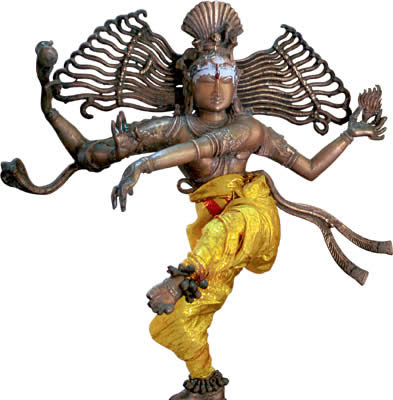
The second floor of the bronze gallery is entirely dedicated to Lord Nataraja. Here is an idol, with the Lord standing on his right foot, just as in madurai, just that here there are only 4 arms. The sculptures differentiate Natesa and Nataraja. Natesa, i think, refers to the Lord of Dance (as an art form) while Nataraja refers to the Lord of Cosmic Dance. Nataraja is generally depicted with the encircling arc of divine fire, while Natesa shows dance mudras and is devoid of the encircling divine fire arc.

There is an entire section dedicated to Maha Vishnu. There is a wonderful sculpture of the Lord with four arms, shankam, charam and gadha. Wonderful to see such an image at close quarters.

There is Maha Vishnu in seated form, quite unlike that I have seen before. Here, the Lord is seen with 2 arms, with the shankham in the left palm and charam in the right palm. You have to strain your eyes to see both these, but is very pleasing to the eye.


The best was reserved for the last. There are 2 wonderful sculptures of Lord Hanuman. Firstly, he is seen with Lord Rama, Lakshamana and Sita. Here, he is seen in the pose of a disciple, with hand covering his mouth. Another idol is a shiny valiant form with hands folded.


You need a good 2 hour window to spend in the bronze gallery, but one occasion where bronze is better than gold :)

Saturday, February 12, 2011

How to remember aspects of noun/pronoun and verbs in Samskritam

What makes samskrit crisp and succinct is the way its grammar is structured. As most students, I too struggled with the grammar. Introduction of Bhakti (quite literally) can go a long way in learning Samskritam.

Ok, apart from the Gyan, we know that the nouns have 3 aspects i.e. लिंगम- Gender, Cases - विभक्ति- that relates how the action relates to the noun/pronoun, वचनं - number that denotes the number of nouns, which is Singular, Dual and Plural (interesting aside is our philosophical systems are also advaita, vishistadvaita and other pluralistic forms of worship). So, I found out it easy to remember this as -"Devotional words for Lord Shiva Lingam" - (वि) भक्ति वचनं लिंगम - (Lingam - Shiva; Bhakti - Devotion, Vachanam - words).

Similarly, verbs have 3 aspects to them - कालः - time - past, present and future; पुरुषः- person, वचनं- denoting the number of nouns related to the verb. So, its easy to remember this " The words of KalaPurusha" as कालः पुरुषः वचनं- (Kala Purusha as Shodasha Kala Purusha indicated in the Taittirya Upanishad - http://en.wikipedia.org/wiki/Taittiriya_Upanishad ).

Link on grammar - http://www.ibiblio.org/sanskrit/start/nouns/

Tyaagaraja - Lost and Found feeling :)

One the most fascinating aspects of Chennai is its vibrant classical music season or maarghazi utsavam. There was an interesting joke of Facebook sometime back. Musicians sing "Entha ROW mahaanubhavalu", as if to they were asking, which ROW were the rich and famous rasikas sitting :) Quite a take on the pompous displays in the kutcheris these days :)

That apart, listening to this wonderful composition during Tyagaraja aaradhanai in tiruvaiyaru is quite a moving experience. So, it seems the saint sang this song when he was invited to sing in the house of his Guru, Sonti Venkataramanayya (http://en.wikipedia.org/wiki/Tyagaraja). What an experience it would have been to have heard this composition from the master himself !

One of the highlights of my visit to Tiruvaiyaru, was the darshan of the wonderful idol of Lord Rama in the temple. Its a small idol with Lord Rama, Lakshamana and maa sita in standing position. I distinctly remember that maa Sita was on the left of the Lord and that I thought was not quite usual. I did not dig further. The sight of the Lord Rama was quite moving. It was quite an emotional experience to see that wonderful idol of Rama that was the source of life long inspiration for the Saint. Well, it seems that the idol there is only one of the many idols that the Lord that Saint Tyagaraaja had. Now, as I travel back in time, my curiosity increases to know where the idol, that the Saint felt so emotionally attached (that his brother had to throw it into the river) was? So, it turns out that the shining idol that Lord Rama blessed Tyaagaraja is in simple home in Varagappaiyer Street, Thanjavur. The group of idols has Rama and Sita in a seated pose with Bharata holding the umbrella, Shatrughna the ‘chamaram' and Lakshmana standing on the right side of Rama. All musicians come to this place during the Tyaaraja aaradhanai to get blessings. Now, that goes right up there in places to visit :) (http://www.thehindu.com/arts/history-and-culture/article1271764.ece).

While on that topic, there is a small story on why Lord Rama played this "leela" and forced Jalpeshan to throw the idols into the river. As Embar VijayaRaghavachar puts it, Lord Rama wanted to find out, that if Saint Tyagaraaja sangs such beautiful songs in his (Lord Rama's) presence, how much more sweeter and intense would be the songs if he separated himself from devotee. So, the Lord plants this idea in the mind of Jalpeshan. Saint Tyaaraja melts unable to bear the separation from his beloved Lord Rama and sang "Endu daagi naado" , where has he gone? How much pain would he have endured for the 3 months when he was separated from the Lord, almost like a mother cow separated from its, unable to express the pain. And who can even imagine the joy of the Saint, when re-united with his beloved Lord Rama.

Another great aspect of the Saint Tyaaraja as I see it, he had great affection of Lord Shiva as well. Just like Ramakrishna paramahamsa, his love for Lord Rama also inspired him to look at this same aspects in Lord Shiva (http://www.shaivam.org/ste_tyagaraja.htm#shiva_shiva). Great saints are beyond Nama, roopa bheda. It give me a high when I think that we tread the same earth as this wonderful saint. What else can I say..... " Endaro Mahaanubhavulu" ...

Monday, January 31, 2011

Yoga Vasishta - Lord Rama as a student


Ramayana has always been a source of inspiration. For any student, Lord Sri Rama is an ideal role model. Rama is described as a eka santha grahi (one who can grasp any knowledge at the first attempt). Such was the power of concentration, interest and love for knowledge :)

I was always interested in understanding the relationship between the Lord and his Guru. Yoga Vasishta is the apt text to understand this subtle relationship and revel in the role of Sri Rama as the ideal student. Here, it would be pertinent to bring out the subtle comparison with the Bhagavad Gita, where the Lord is the teacher and Arjuna is the student. Sri Rama's questioning seems crisp, and precise and that of a student determined to seek the truth while Arjuna's approachis that of a confused student.

The setting of Yoga Vasishta is right after the gurukala vasam of Lord Sri Rama and before Vishwamitra's arrival. Sri Rama, just like, Siddhartha wants to understand the reason behind the pursuit of pleasure and subsequent pain, the impermanent nature of life and the pursuit of truth. Sri Rama refuses to go with Vishwamitra unless he gets clarity on the above topics. So, the stage is set for the delivery of Yoga Vashishta.

I can relate to how happy, Vashista would have felt on having such a worthy student :) Vasishta mentions in the first chapter that this text is meant for aspirants who feel "bound in this world" and aspire to be liberated, meant for aspirants who are neither totally ignorant nor spiritually illumined. Again, this seems to be like the specifications are designed for Lord Rama ... quite Bhagavad Gita, where the Lord prepares his student, Arjuna, for the message that he is going to deliver :)

What is stunning is the way the first chapter concludes. Lord Rama says that he knows that he does not have the answers to the questions related to supreme truth (quite unlike the fountainhead of spiritual bliss), but is ready to face any physical hardships to attain this knowledge. Lord Rama goes on to say that he will abandon all desires and remain in complete silence (like a picture/sculpture) till he receives the knowledge by the blessings of his Guru :) Makes me wonder if the Lord is still standing in his silent glowing benevolent form all over our country, reminding us about the day he took this vratam in the pursuit of spiritual knowledge and peace:)


NOTE : points referred from Yoga Vasishta Sara Sangraha - Swami Tejomayananda - Chinmaya Mission Trust

Saturday, September 25, 2010

Obituary opulence

Well, a few things seem to have triggered this mega frenzy that I call Opulence in Obituary advertising in Chennai, namely - low cost of digital printing, high court order banning hoardings and the ruling government/party politics. Thanks to all this, I now know the enormous contributions made by one Mr. Dasarathan, party functionary of the ruling party, the everlasting heroics of Dhanu, a local socially challenged individual, and the loving sons of Mrs. Muniyamma. How do I know them? Well, everyday I see all these people brought to life by colorfully printed digital obituary ads standing on causaurina legs :) Each of these posters are mini resumes, like the ones by Raja Raja Chozha in the Thanjavur temple. It talks about the legendary social contributions that these people made and also enumerates the photos of people who are ever grateful for these contributions. The template of these ads are well designed. Each banner has a section with a significant portion dedicated to the party or gang that the person is affiliated. It has a section that has a poetry (oh good, I hate to insult the word poetry), depicted in a scroll and the bottom half dedicated to well wishers. It is mandatory that all these well wishers have a photo with a cell phone in their ears :) All these ads are strategically erected in the directions of flowing traffic to attract maximum attention. Most of these public obituary ads are in politically well endowed, socially less sophisticated neighbourhoods.

Ok, now before you dismiss this as a "bottom of the pyramid" phenomenon, I would like to draw your attention to the annals of "The Hindu" newspaper. This is the realm of pseudo sophisticated people like me and my family :) Wonder if you studied the obituary section carefully. Again, there is a neat pattern of pompous self promotion of the dead and the soon-to-be-dead. So, what is the pattern? Every obituary ad will essentially contain 3 neat sections. First the photo. The second section right below the photo will contain the name of the person, the office he worked in, the position, the degrees, the certifications, the medals, the achievements, and if possible bank balance and account numbers :) For rama's sake, the dude is dead and all these don't matter. All I need to know is the name and work place at best. Does it matter if he was post master general (retd.), BTW you cannot miss the retired part, lest the people think that the person died in harness :) You need to mention which country the person did his M.S. If the person has any long lost connection with the US, it is a must :) So, that is about the dead person. The section on not-yet-dead people is more interesting. So, the list starts with the name of the person, relation with the dead person, his/her academic qualifications, his/her work experience profile,his/her location (very very important if they are anyway outside India, even if its Papua New Guinea, please mention it). Each obituary ad is a mini resume for the family of the dead :)

Adi Shankara said," Maa kuru dhana jana yauvana garvam" - Don't be proud of your wealth, people or youth as the Lord can take it away anytime. The obituary opulence defies all logic :) but then, that is why the cut-off is so low in Kali Yuga :)

Tuesday, July 6, 2010

Swamiji's last few days on earth (nishthatmananda of muzaffarpur)

We came to this earth with cries, but while leaving we have to smile and express joy in our face.


“During our life time, if we are blessed to smile, that it self is a great achievement and how can we guarantee our smiling while we leave this earth, the time which is not under our control?” – That’s a genuine question.


We have the life of Swami Vivekananda that gives us the necessary guidance to prepare for ourselves for the joyful journey. All through his life, Swamiji tuned every event as preparation for his ultimate journey.


In the year 1898, Swami Vivekananda during his pilgrimage to Amarnath, had received a boon from Lord Shiva not to die until he himself should choose to do so.


Sri Ramakrishna had said about Narendranath that ‘when he realizes who and what he is, he will no longer remain in the body’.


Hence, as a village boy, who had never seen an aero plane on the earth and who had been told that he would be taken in an air travel next week, would eagerly await for the golden day of his air travel, so also Swamiji was waiting to take up his eternal flight to be boarded by him on July 4, 1902 the day which was chosen by himself. Here below are a few events on his last day of physical existence.


· On July 4, 1902 during his 2 hours morning meditation in the shrine of Ramakrishna, he had the doors and windows closed, while he was accustomed to meditate only in a well-ventilated room. Coming down from the shrine, he had a walk in the courtyard. While walking he spoke to himself in a half-audible tone: “If there were another Vivekananda, he would have understood what (this) Vivekananda has done! And yet,-how many Vivekanandas shall be born in time!”


· He had his noon lunch along with all, which was again quite unusual, since owing to his ill health he used to take his meals in his own room. On that day he ate full meal and remarked humorously,” two days before, owing to my fast for ekadasi on Wednesday, my hunger has greatly increased. I ate full meal but left the cups and plate (without eating them up) with great difficulty.”


· After a short rest, Swamiji took class on Sanskrit grammar to young brahmacharins for three hours and made the class so interesting that no one felt any monotony.


· During his evening walk along with Swami Premananda he expressed his desire of founding a Vedic college at Belur Math. Premananda asked him,”What, Swamiji, will be the good of studying the Vedas?” for which Swamiji replied, ”It will kill out superstitions”.


· In the evening after the prayers, he sat for meditation. After an hour’s meditation he called his attendant, lying down on his bed with the rosary in his hand. He asked him to fan his head. After another hour or so, his attendant noticed that Swamiji’s hand shook slightly; then he took two deep breaths; the gaze became fixed at the eye brows and the face lit up by an extra ordinary radiance and smile. His head rolled to one side and then all was silent. It was seen in the next morning that the eyes were bloodshot and that a little bleeding had occurred through the nostrils and mouth.


Lord Krishna says in the 8th chapter of Gita, “At the time of passing away whoever fixes his prana between his brows and meditates on the Ruler of the world, reaches the Supreme Truth.” Swamiji’s physical death is a yogic Samadhi as stated by Lord Krishna. Swamiji raised his coiled – up spiritual power and made it to pierce through the mystic centres in the spinal column and the head and thrown away the body like a worn-out-garment.


When one is attached to the body and his possessions, death is terrible, but to one who had disciplined his body, death has no threats or no secrets.


Normally, we relate death with sadness, inauspiciousness and fear.


But, it is quite possible to make the event filled with joy, auspiciousness, hope and strength.


God-men like Sri Ramakrishna, Swami Vivekananda and others had thus shown the way to us.


It was Swamiji’s last message to the world – “Welcome the death calmly and boldly.” For Swamiji, death means just getting out of the physical body. As a spiritual force he continues to live and work with us and that is why he said, “I shall inspire men everywhere, until the world shall know that it is one with God.”


July 4th is thus a day of great joy, hope and strength to all followers

of Swamiji. His Master chose to leave His mortal coils on 15th August in the year 1886, knowing well that after 61 years that India would get freedom from foreign rulers. And our Swamiji chose July 4, the day of America's Independence. Though these are occasions for rejoicing country's political freedom, these God-men have chosen to leave the physical frame thus symbolising that death is not a sad event but a step towards eternal freedom and bliss.


Let us prepare ourselves from now on to face that great moment filled with happiness, strength and absolute freedom.

Friday, April 30, 2010

Fix-All (www.fix-all.biz) - Chennai .. here we come :)

So, its finally off the ground. Fix-All (www.fix-all.biz) , with the blessings of the Lord of Thillai, was finally in the service of all chennai people :) What did not have? For us, it was disappointment, action, drama, high emotions, and finally joy :)And what a co-incidence, Chennai Super Kings win the IPL and we gift Chennai with Fix-All (For us, it almost rivaled the IPL season). We need to thank our team, who have worked with us to kick start Fix-All. Also, we need to mention Vinod, who created our identity on the web. We will assure all our customers. Our services and our effort have only one way to go :) GET BIGGER AND GET BETTER.

It was a great show of support from friends and family :) We finally launched Fix-All. We are getting queries related to A/Cs, inverters, low voltage issues and general support. We are following a simple process right now.

Step 1) Request registration : As soon as we get a request, on phone, SMS or through the internet, we take the request after informing the customers about our service.

Step 2) Acknowledgment and Appointment : We inform our electricians about the customer details and ensure that they acknowledge the customer request and fix an appointment according to customers requirements.

Step 3) Customer Service delivery : Ensure that our electricians to ensure that they have visited the customer. Also, make sure that they explain the billing, the work done and give you a bill for the service rendered.

Step 4) Customer feedback : We call up/e-mail the customer to check if our service was up to their expectations.


We will need your support and feedback to deliver good service to you. Please send us feedback on our website/phone :)

Chennai, here we come :)

Wednesday, February 17, 2010

Kaal Taxi - New age Yama vahaanam

Even wondered that how does Mr. Yamraja operate in Indian cities these days, given that his favourite agent, the buffalo is off the roads? A 2008 statistic shows that 50% of all vehicles seized for dangerous driving were "Kaal-Taxis". And there is your answer.

Be afraid, be very afraid. Just when you thought you had rendered Mr.Yamaraja vahan-less with the removal of buffaloes from the street, he has outsourced the service to Kaal-Taxis (Kaal- as in MahaKaal, the lord of death and destruction).Look at the name is its obvious. Most of these taxis as Tata Indicab, indicating, TATA, time to go.

Precautions to take when you encounter a Kaal-Taxi.
1) Always take refuge in cephal-ishwar - the helmet. Just as Markandeya swami was protected by Kapaaleshwar, when confronted by Yama, the helmet is your only savior here.

2) Avoid looking into the eyes of the driver of Kaal taxi. Its often taken as a challenge. Many of you would not know that these drivers have never used the vehicle brakes in their lifetime. Its below their dignity to touch the brake, and so do not challenge these guys for a race by looking into their eyes.

3) These Kaal-taxi guys always have their FM channels blaring. It doubles up as a warning to people who are around that, death is very close to them. In case, you want to please him, you can call up the radio station and dedicate a song to them. They might be pleased and forgive you.

4) There is always a sticker on the back of these Kaal-Taxis asking people to inform them if you see the driver driving harshly. You will never ever be able to reach those numbers. Heck, have you ever heard of anyone calling Yamaraja. He does not take orders/feedback. He comes at his will.

5)Worldy rules do not apply to Mr. Yama or his Kaal-taxis. So, do not expect them to follow any traffic rules.

So, remember to thank you lord for giving you one more lease of life after every encounter with the deadly - Kaal taxis.

Friday, October 9, 2009

The Nobell Knight :)

Naturally, i was overjoyed by announcement of Nobell peace prize. What comes to my mind are the memorable dialogs from the The Dark Knight (2008). What I tried is to replay the dialog in the various scenes with the protagonist,Mr. Bhama, (a recent Nobell Prize Winner for peace) and rest of the characters being the same. Before you jump to conclusion about my protagonist, let me declare that Mr. Bhama is a figment of my imagination. Bhama apparently means light in Samskritam and I thought the name suite the Hero, who seems to be the only ray of hope in the world of "The Jokers". Please refer to the original dialogs (http://www.imdb.com/title/tt0468569/quotes).

*********************************************************************************
Scene 1: Mr. Bhama is rudely (yet respectfully) woken up by Alfred Pennyworth. He announces that Mr. Bhama has won the Nobell peace prize and how there are some skeptics were howling out there.

Mr. Bhama: Targeting me won't get them the prize back. They crossed the line. They are blaming me for paucity of hope.

Alfred Pennyworth: You crossed the line first, sir. You squeezed them, you talked and lectured the world to the point of desperation. And in their desperation they they did something that they didn't fully understand.

Mr. Bhama: Yeah, the prize committee members aren't complicated, Alfred. Just have to figure out what they're after.

Alfred Pennyworth: With respect, sir, perhaps this is a prize that *you* don't fully understand.

************************************************************************************
Scene 2 : but Why ????

Mr. Bhama: Then why give the Nobell prizes in the first place?

Alfred Pennyworth: Because the committee thought it was good sport. Because some men aren't looking for anything logical, like money. They can't be bought, bullied, reasoned or negotiated with. Some men just want to watch the world get confused.

************************************************************************************
Scene 3: Conversation between Mr. Bhama and The Joker

The Joker: Oh, you. You just couldn't let the prize nomination go, could you? This is what happens when an unstoppable speaker meets an immovable (read dumb) committee. You are truly incorruptible, aren't you? Huh? You won't let go of this prize out of some misplaced sense of self-righteousness. And I won't stop poking you because you're just too much fun. I think you and I are destined to do this forever.

Mr. Bhama: You'll be in this illusion forever.

The Joker: Maybe we can share one. You know, they'll be doubling up, the rate this committee's members are losing their minds.

Mr. Bhama: This prize committee just showed you that it's full of people ready to believe in good humor.

The Joker: Until their spirit breaks completely. Until they get a good look at the real heroic Tibetan monk and all the heroic things he's done. You didn't think I'd risk losing the battle for World's peace in a fistfight with you? No. You need an ace in the hole. Mine's monk.

Mr. Bhama: What did you do?

The Joker: I invited him over to our country and I brought him down to our level. I made you run scared in that funny costume to avoid a monk :) It wasn't hard. You see, madness, as you know, is like gravity. All it takes is a little push!

[the Joker laughs hysterically as Mr.Bhama races off and the cops come to take the Joker into custody]

************************************************************************************
Scene 4: Mr. Bhama meets Joker

Mr. Bhama: Then why do you want the peace prize?

The Joker: [laughs] I don't want the peace prize! What would I do the prize? Go back to supplying arms to rogue countries? No, no, NO! No. I just want to play with You... you... complete me.

Mr. Bhama: You're garbage who buys nobell prizes for money.

The Joker: Don't talk like one of them. You're not! Even if you'd like to be. To them, you're just a freak, like me! They need you right now, but when they don't, they'll cast you out, like a leper! You see, their morals, their code, it's a bad joke. Dropped at the first sign of trouble. They're only as good as the world allows them to be. I'll show you. When the chips are down, these... these civilized people, they'll eat each other. See, I'm not a monster. I'm just ahead of the curve.

Mr. Bhama: Where's Monk, I want to show him the prize?

The Joker: You have all these prizes, and you think they'll save you? Bad Karma always catches up dude :)

************************************************************************************

Tuesday, September 29, 2009

Vyasa on Vices


It is not very difficult for us to imagine how difficult life in Kaliyuga is going to be. I was always wondering what our rishis had to say about Kali Yuga and what foresight they had about the iron age (Kali yiga).

I happened to read Vidyeshwara Samhita from Shiva Mahapuranam and that was very interesting. It seems Vyasa had visions into how much life would be degraded (well... its again perception .. some would say .. depending on our faith in scriptures, our history and willingness to open up to ancient wisdom). So, Suta, disciple of Vyasa, describes the following as significant indicators of Kali Yuga.

People in Kali Yuga would engage earning pleasure by usurping wealth and wives of others. They would not be able to differentiate between the body and self (brahman). They would invariably be atheists, be passionate by nature and denounce their parents.

Those who are responsible to learn the vedas, will be greedy by nature, earn living by selling knowledge(vedas) and get intoxicated by learning worldly knowledge (devoid of knowledge of brahman). They would indulge in cheating others, not perform sandhya vandanam (how can Vyasa come so close) and be foolish. They would be merciless and consider themselves very learned by learning worldly knowledge. They would not have knowledge about shastras. They would have very harsh temperament and be deceitful (how close).

Those who are supposed to be protectors of people, will never take side of noble people (if any). They would be engaged in corrupt,sinful activities. They would be cowards by nature and fear the battle field when it comes to defending their people. They would earn their living by stealing from people that they are supposed to protect. They would always be engaged in passionate activities. They would not have knowledge of weapons. They would indulge in destruction of their own people and kill creatures without any reason.

Those who are supposed to do business, would be engaged in earning wealth by evil tricks of trade. They would not engage in charity or support vedic learning. There would be complete loss of ideals and business people would derive pleasure by snatching wealth and wives of others.

Those who are engaged in providing labour support, would benefit from the degradation of all other sections of society. They would find ways of evading work and behave as protectors of vedic knowledge. They would become wealthy, engage in evil deeds, become learned, incite controversies, give lectures on dharma and destroy dharma. They would act as kings, project themselves are donors and protectors of society, be extremely proud and punish/denounce vedic learning. They would derive pleasure in oppressing people pursuing vedic ideals.

Like men of this age, women would also indulge in misconduct. At home,they would engage in cooking of prohibited/non-sattvic food. Children from such households would not be interested in service of their parents. They would learn un-holy knowledge and be extremely proud and arrogant. They would suffer from various physical ailments right from childhood.

From here, the sivapuranam goes on with how the defects of Kali Yuga can be addressed. Now, what is interesting is Veda Vyasa's ability to perceive the social unrest several thousands of years in advance.

Reading this also gives me a sense of relief. I always had this sense of unrest in my mind. Why is everyone (including me) behaving in such a way that seems to so chaotic. There seems to be a feeling of discontent and mismatch in everything that is around me. Now, reading this section of SivaPuranam shows that this was not unexpected. People, have foreseen this problem, several thousands of years in advance, to such a granular level. So, the good thing is there might be an antidote to this unrest in our minds. I am sure other scriptures and puranas would also have some mention of the ailment and its cure. Now, all I need to do is find the cure and implement it on myself to see if it works :)

Friday, August 21, 2009

Taskaranaam Pataye Namo Namo - Salutations to the lord of thieves (Rudram)

My salutations to the lotus feet of the Lord who steals unholy thoughts from the hearts and minds of his devotees.

I found a rather interesting article on how an dacoit from UP decided to erect a statue for himself (http://timesofindia.indiatimes.com/news/india/UPs-ex-dacoit-to-put-up-own-statue-/articleshow/4913201.cms). The 59 year old dacoit did not have a fairly tale rise in the field of politics after an rather dull career as a dacoit. To quote the ex-dacoit (sounds fancy like ex-MP, ex-MLA, though the JD is rather similar), Jagannath Bind, "If people can erect statues of themselves, why not me?".

What attracted my attention was a slightly different point in his reasoning. Jagannath Bind was inspired by Valmiki to turn a new leaf. Now, I am not sure how much of this is true, but that is certainly inspiring. How many of us actually look upto inspiration from the history to turn a new leaf in life? I cannot talk on behalf of anyone else, but personally, I have a long way to go to reach my own personal ethical/moral benchmarks and have never corrected myself inspite of having read about many of these mahapurushas. My biases are intact; my mind is wavering and deceitful; my senses are not under control; lack of discipline; superficial bhakti; and the list is unending.

How inspiring the story of TulsiDas (http://www.ramcharitmanas.iitk.ac.in/manas1/html/tulsim.htm), whose love of worldly life was switched into love of Rama in a second. Yogi Vemana (http://www.manmaking.com/Chastity/Stories.html#_Toc441557047) saw the dawn of intense vairagya by the blessings of Lord Shiva. I can only hope that the Lord shows his mercy on my fickle mind.

Now on the point on how I can make an effort to develop Bhakti, I want to highlight a lecture by Periyava (Voice of God, "The third way"), in which he talks about 3 ways in which we can approach the Love of Lord based on our mental capabilities. 2 of them are मर्कट किशोर न्याय (Markata Kishore Nyaya) and मार्जार किशोर न्याय (Maarjara Kishora Nyaya).

The cat family (including the tiger) have very sharp teeth. Inspite of their ferocious teeth, they are able to carry their kittens with utmost care, holding them by the same sharp teeth that can shread the toughest of their prey. Hence, the kitten (मार्जार किशोर) are effortlessly carried by their mothers without the slightest harm. Such an approach to, Bhakti in which devotees the Lord in their hearts and leave it to AmmaiAppan (the lord who is their father and mother) to carry them safely in this tumultuous world, is called Markata Kishora Nyaya.

Another approach to Bhakti is like that of a baby monkey (मर्कट किशोर), which clings to its mother's abdomen. The mother monkey does not have to bother about the baby monkey even when it jumps across branches.

Adi Shankara has the antidote for our minds in the Kali Yuga. He says in the SivanandaLahiri

"Me hridayakapim athyanatha chapalam
Dhridham bhaktya bhadhva Shiva, bhavadh aadhinam kuru Vibho"

Which translates to, "O Lord, my mind/heart, which is like a monkey, is very fickle. Please bind it firmly by the rope of bhakti and make it subservient to you.

Reflecting on it, these are days of scientific temper. We do not have the capacity to "let go" and leave ourselves to the flow of affection from the Lord. We also do not have the determination to "cling on" to the bhakti marga. Adi Shankara BhagavatPada seems to have understood our inability to follow wither of these. Hence, suggested that we pray to the Lord and request him to take control our our lives, putting the responsibility on our beloved Lord to take control of our mind and lives. A classic example in this case is how Sundarar asked the Lord that he take control of his life just when he is likely to get carried by the waves of Maya.

What I take solace is the world is full of instances of people reforming by looking at examples from our glorious spiritual past. I pray that, just as the decoit changed his ways by seeking inspiration in Valmiki, let me be inspired, by all these saints, to tread the sweet path of Bhatkti.

Sunday, July 19, 2009

Spirituality and Corporate Governance- RaviC and Gurumurthy

RaviC and Sri S. Gurmurthy on the same stage was always going to be interesting. Chennai welcomed these 2 interesting speakers with ceremonial sprinkling of auspicious water and manvasanai.

Having attended RaviC's class, I knew his style of lecture delivery. He had neatly segmented his talked into 4 parts. His subtle humor undercurrent was visible as he talked about the evolution of management education and how its seeds were sown in India. He described how we neatly copied the American management school of thought and applied it to India, not fully understanding its impact.

The first section of RaviC's talk was about the evolution of corporations in America. Corporations rose on the pillars of "purpose, knowledge and innovation". He talked about how Ford was focused on his purpose of delivering a car that was useful for farmers. The corporation did very well for itself and the society as it focused on this "purpose". As corporations grew, they started focusing on performance at the Wall Street and the "purpose" of the organization become to deliver superior results Q-o-Q. Finally, it reached a stage when corporations became focused on the "purpose" of delivering "performance at the Wall Street at any costs". Corporations, that were initially, a part of the social fabric, became entities that bothered about its own well being. This toxic unbridled greed eventually shook the very society that it sought to serve. It was an interesting perspective. I was reminded of the maxim "Bahujana Hitaya, Bahujana Sukhaya" which means for the benefit for "maximum number of people and for the happiness for maximum number of people". It makes me wonder if corporations think that the world economy zero sum game... someone has to lose for someone else to win :)

Next, RaviC went on to talk about how the ecosystem and the society, in general is forcing the its younger generation into parochial system of materialistic excellence. Students walking out of premier educational institutions aspire to be materially successful and finally become become brands or icons. I guess, he was trying to point out that this race again makes them aspire for "performance at any cost" even if it hurts the very society that nurtured, admired and valued them for being superior performers. The lack of spiritual insight into life fails to temper the material aspirations of our extremely talented young professionals thus eventually turning them into gods with feet of clay.

RaviC talked about how he introduced several programs at IIM-Indore on spirituality and management. I just pray that these initiatives pay off and we can create spiritually mature business leaders - Rajarishis.

Now, any effort from my part, will fail to recreate the subtle humor that RaviC effortlessly weaves into his lectures.

Sri. Gurumurthy is a very energetic speaker. The point in his speech that impressed me most was the transition of societies from "relationship based societies" to "contract based societies". It was subtle but interesting concept that I did not notice for so long. It was glaring how the change in our society was staring at my face and I did not realize this. Superficially, it would look like contract based societies would be more efficient. The interfaces between individuals, families, states are based on contracts between parties. Finally, it has come to the extent that parents, children, husband, wives, brothers and sisters are bound by just contracts. Today, we have contracts with gods. Students feel that teachers are bound by contracts because of the fees that pay. How will we ever learn if we just try to assess if our teachers are fulfilling our contracts. I don't think I have either the knowledge or the skills to argue on this topic. I have a ton of things to learn and very little time left.

Coming back to the main topic, I feel that many issues arise in corporations as they see themselves bound by contracts to the government, to its employees and some sections of the society. They try to make sure that these contracts are adhered to. Hence, this becomes an exercise of legal compliance rather than overall social well being. Transition of mindset of our corporate leaders into thinking how they relate to the society will help them govern themselves better. This will help them think on the lines of "Bahujana Hitaya, Bahujana Sukhaya" and eventually focus on purpose rather than just "performance at any cost".