Monday, February 14, 2011

Go for the bronze @ Government Museum - Egmore, Chennai


So, mission accomplished. Government Museum Chennai- Egmore. Value for money @ Rs. 15. And all that money goes to the bronze gallery (one of the 6 galleries), though I must say there are 2 more that I need to visit. For starters, the bronze gallery is air conditioned, so it certainly has a head start, but there are some interesting parts of the bronze gallery that deserve credit.

Now, the bronze gallery was very well lit. Glass enclosures, with neat mirrors and focus lighting helped appreciate the intricate art work. The link to the gallery - (http://www.chennaimuseum.org/draft/gallery/b3.htm).


It was good to start with the first gallery, which has stone sculptures. The notes there are crisp and small. So, without really bogging the visitor, it tells how to differentiate among Pallava, Chozha and Vijayanagar art forms. For people like me who have lost touch with all this, it is pretty informative. Just a look at the sacred thread (number of strands, where the sacred knot in the thread is) worn by the Lord/ Divine mother can help identify the period of the sculpture. The stone sculpture gallery is just 2 floors.


The bronze gallery starts with wonderful sculptures of Lord Tripurantaka (http://en.wikipedia.org/wiki/Tripurantaka). Lord Shiva is seen wielding a bow (and a smile) before he embarks on the destruction of Taarakaaksha, Kamalaaksha and Vidyunmaali (and the ego of the gods, who think its because of them that the Lord will be able to defeat these invincible demons).

Now, Vishapaharana is one form of Lord Shiva that I had not known before. Here, the Lord is in a seated position with a snake in his palm. The snake is facing the Lord. Looks like the Lord will ensnare the poisonous snake of Maya for devotees who seek refuge in him.

There is a nice sculpture of Kannapa Nayanar. The details of his sword and Sandal show the intricacy of the art work.

There are a couple of sculptures of Goddess Durga, just as it in Patteswaram (http://en.wikipedia.org/wiki/Patteeswaram), complete with the shankam, chakram and the parrot on her palm. The details are striking.


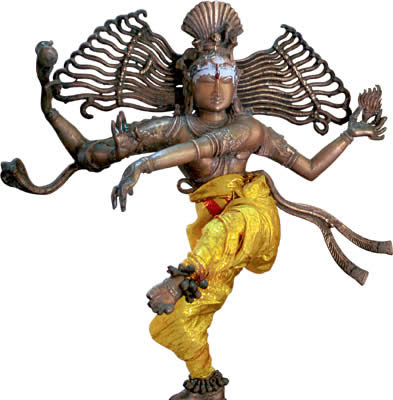
The second floor of the bronze gallery is entirely dedicated to Lord Nataraja. Here is an idol, with the Lord standing on his right foot, just as in madurai, just that here there are only 4 arms. The sculptures differentiate Natesa and Nataraja. Natesa, i think, refers to the Lord of Dance (as an art form) while Nataraja refers to the Lord of Cosmic Dance. Nataraja is generally depicted with the encircling arc of divine fire, while Natesa shows dance mudras and is devoid of the encircling divine fire arc.

There is an entire section dedicated to Maha Vishnu. There is a wonderful sculpture of the Lord with four arms, shankam, charam and gadha. Wonderful to see such an image at close quarters.

There is Maha Vishnu in seated form, quite unlike that I have seen before. Here, the Lord is seen with 2 arms, with the shankham in the left palm and charam in the right palm. You have to strain your eyes to see both these, but is very pleasing to the eye.


The best was reserved for the last. There are 2 wonderful sculptures of Lord Hanuman. Firstly, he is seen with Lord Rama, Lakshamana and Sita. Here, he is seen in the pose of a disciple, with hand covering his mouth. Another idol is a shiny valiant form with hands folded.


You need a good 2 hour window to spend in the bronze gallery, but one occasion where bronze is better than gold :)

Saturday, February 12, 2011

How to remember aspects of noun/pronoun and verbs in Samskritam

What makes samskrit crisp and succinct is the way its grammar is structured. As most students, I too struggled with the grammar. Introduction of Bhakti (quite literally) can go a long way in learning Samskritam.

Ok, apart from the Gyan, we know that the nouns have 3 aspects i.e. लिंगम- Gender, Cases - विभक्ति- that relates how the action relates to the noun/pronoun, वचनं - number that denotes the number of nouns, which is Singular, Dual and Plural (interesting aside is our philosophical systems are also advaita, vishistadvaita and other pluralistic forms of worship). So, I found out it easy to remember this as -"Devotional words for Lord Shiva Lingam" - (वि) भक्ति वचनं लिंगम - (Lingam - Shiva; Bhakti - Devotion, Vachanam - words).

Similarly, verbs have 3 aspects to them - कालः - time - past, present and future; पुरुषः- person, वचनं- denoting the number of nouns related to the verb. So, its easy to remember this " The words of KalaPurusha" as कालः पुरुषः वचनं- (Kala Purusha as Shodasha Kala Purusha indicated in the Taittirya Upanishad - http://en.wikipedia.org/wiki/Taittiriya_Upanishad ).

Link on grammar - http://www.ibiblio.org/sanskrit/start/nouns/

Tyaagaraja - Lost and Found feeling :)

One the most fascinating aspects of Chennai is its vibrant classical music season or maarghazi utsavam. There was an interesting joke of Facebook sometime back. Musicians sing "Entha ROW mahaanubhavalu", as if to they were asking, which ROW were the rich and famous rasikas sitting :) Quite a take on the pompous displays in the kutcheris these days :)

That apart, listening to this wonderful composition during Tyagaraja aaradhanai in tiruvaiyaru is quite a moving experience. So, it seems the saint sang this song when he was invited to sing in the house of his Guru, Sonti Venkataramanayya (http://en.wikipedia.org/wiki/Tyagaraja). What an experience it would have been to have heard this composition from the master himself !

One of the highlights of my visit to Tiruvaiyaru, was the darshan of the wonderful idol of Lord Rama in the temple. Its a small idol with Lord Rama, Lakshamana and maa sita in standing position. I distinctly remember that maa Sita was on the left of the Lord and that I thought was not quite usual. I did not dig further. The sight of the Lord Rama was quite moving. It was quite an emotional experience to see that wonderful idol of Rama that was the source of life long inspiration for the Saint. Well, it seems that the idol there is only one of the many idols that the Lord that Saint Tyagaraaja had. Now, as I travel back in time, my curiosity increases to know where the idol, that the Saint felt so emotionally attached (that his brother had to throw it into the river) was? So, it turns out that the shining idol that Lord Rama blessed Tyaagaraja is in simple home in Varagappaiyer Street, Thanjavur. The group of idols has Rama and Sita in a seated pose with Bharata holding the umbrella, Shatrughna the ‘chamaram' and Lakshmana standing on the right side of Rama. All musicians come to this place during the Tyaaraja aaradhanai to get blessings. Now, that goes right up there in places to visit :) (http://www.thehindu.com/arts/history-and-culture/article1271764.ece).

While on that topic, there is a small story on why Lord Rama played this "leela" and forced Jalpeshan to throw the idols into the river. As Embar VijayaRaghavachar puts it, Lord Rama wanted to find out, that if Saint Tyagaraaja sangs such beautiful songs in his (Lord Rama's) presence, how much more sweeter and intense would be the songs if he separated himself from devotee. So, the Lord plants this idea in the mind of Jalpeshan. Saint Tyaaraja melts unable to bear the separation from his beloved Lord Rama and sang "Endu daagi naado" , where has he gone? How much pain would he have endured for the 3 months when he was separated from the Lord, almost like a mother cow separated from its, unable to express the pain. And who can even imagine the joy of the Saint, when re-united with his beloved Lord Rama.

Another great aspect of the Saint Tyaaraja as I see it, he had great affection of Lord Shiva as well. Just like Ramakrishna paramahamsa, his love for Lord Rama also inspired him to look at this same aspects in Lord Shiva (http://www.shaivam.org/ste_tyagaraja.htm#shiva_shiva). Great saints are beyond Nama, roopa bheda. It give me a high when I think that we tread the same earth as this wonderful saint. What else can I say..... " Endaro Mahaanubhavulu" ...

Monday, January 31, 2011

Yoga Vasishta - Lord Rama as a student


Ramayana has always been a source of inspiration. For any student, Lord Sri Rama is an ideal role model. Rama is described as a eka santha grahi (one who can grasp any knowledge at the first attempt). Such was the power of concentration, interest and love for knowledge :)

I was always interested in understanding the relationship between the Lord and his Guru. Yoga Vasishta is the apt text to understand this subtle relationship and revel in the role of Sri Rama as the ideal student. Here, it would be pertinent to bring out the subtle comparison with the Bhagavad Gita, where the Lord is the teacher and Arjuna is the student. Sri Rama's questioning seems crisp, and precise and that of a student determined to seek the truth while Arjuna's approachis that of a confused student.

The setting of Yoga Vasishta is right after the gurukala vasam of Lord Sri Rama and before Vishwamitra's arrival. Sri Rama, just like, Siddhartha wants to understand the reason behind the pursuit of pleasure and subsequent pain, the impermanent nature of life and the pursuit of truth. Sri Rama refuses to go with Vishwamitra unless he gets clarity on the above topics. So, the stage is set for the delivery of Yoga Vashishta.

I can relate to how happy, Vashista would have felt on having such a worthy student :) Vasishta mentions in the first chapter that this text is meant for aspirants who feel "bound in this world" and aspire to be liberated, meant for aspirants who are neither totally ignorant nor spiritually illumined. Again, this seems to be like the specifications are designed for Lord Rama ... quite Bhagavad Gita, where the Lord prepares his student, Arjuna, for the message that he is going to deliver :)

What is stunning is the way the first chapter concludes. Lord Rama says that he knows that he does not have the answers to the questions related to supreme truth (quite unlike the fountainhead of spiritual bliss), but is ready to face any physical hardships to attain this knowledge. Lord Rama goes on to say that he will abandon all desires and remain in complete silence (like a picture/sculpture) till he receives the knowledge by the blessings of his Guru :) Makes me wonder if the Lord is still standing in his silent glowing benevolent form all over our country, reminding us about the day he took this vratam in the pursuit of spiritual knowledge and peace:)


NOTE : points referred from Yoga Vasishta Sara Sangraha - Swami Tejomayananda - Chinmaya Mission Trust

Saturday, September 25, 2010

Obituary opulence

Well, a few things seem to have triggered this mega frenzy that I call Opulence in Obituary advertising in Chennai, namely - low cost of digital printing, high court order banning hoardings and the ruling government/party politics. Thanks to all this, I now know the enormous contributions made by one Mr. Dasarathan, party functionary of the ruling party, the everlasting heroics of Dhanu, a local socially challenged individual, and the loving sons of Mrs. Muniyamma. How do I know them? Well, everyday I see all these people brought to life by colorfully printed digital obituary ads standing on causaurina legs :) Each of these posters are mini resumes, like the ones by Raja Raja Chozha in the Thanjavur temple. It talks about the legendary social contributions that these people made and also enumerates the photos of people who are ever grateful for these contributions. The template of these ads are well designed. Each banner has a section with a significant portion dedicated to the party or gang that the person is affiliated. It has a section that has a poetry (oh good, I hate to insult the word poetry), depicted in a scroll and the bottom half dedicated to well wishers. It is mandatory that all these well wishers have a photo with a cell phone in their ears :) All these ads are strategically erected in the directions of flowing traffic to attract maximum attention. Most of these public obituary ads are in politically well endowed, socially less sophisticated neighbourhoods.

Ok, now before you dismiss this as a "bottom of the pyramid" phenomenon, I would like to draw your attention to the annals of "The Hindu" newspaper. This is the realm of pseudo sophisticated people like me and my family :) Wonder if you studied the obituary section carefully. Again, there is a neat pattern of pompous self promotion of the dead and the soon-to-be-dead. So, what is the pattern? Every obituary ad will essentially contain 3 neat sections. First the photo. The second section right below the photo will contain the name of the person, the office he worked in, the position, the degrees, the certifications, the medals, the achievements, and if possible bank balance and account numbers :) For rama's sake, the dude is dead and all these don't matter. All I need to know is the name and work place at best. Does it matter if he was post master general (retd.), BTW you cannot miss the retired part, lest the people think that the person died in harness :) You need to mention which country the person did his M.S. If the person has any long lost connection with the US, it is a must :) So, that is about the dead person. The section on not-yet-dead people is more interesting. So, the list starts with the name of the person, relation with the dead person, his/her academic qualifications, his/her work experience profile,his/her location (very very important if they are anyway outside India, even if its Papua New Guinea, please mention it). Each obituary ad is a mini resume for the family of the dead :)

Adi Shankara said," Maa kuru dhana jana yauvana garvam" - Don't be proud of your wealth, people or youth as the Lord can take it away anytime. The obituary opulence defies all logic :) but then, that is why the cut-off is so low in Kali Yuga :)

Tuesday, July 6, 2010

Swamiji's last few days on earth (nishthatmananda of muzaffarpur)

We came to this earth with cries, but while leaving we have to smile and express joy in our face.


“During our life time, if we are blessed to smile, that it self is a great achievement and how can we guarantee our smiling while we leave this earth, the time which is not under our control?” – That’s a genuine question.


We have the life of Swami Vivekananda that gives us the necessary guidance to prepare for ourselves for the joyful journey. All through his life, Swamiji tuned every event as preparation for his ultimate journey.


In the year 1898, Swami Vivekananda during his pilgrimage to Amarnath, had received a boon from Lord Shiva not to die until he himself should choose to do so.


Sri Ramakrishna had said about Narendranath that ‘when he realizes who and what he is, he will no longer remain in the body’.


Hence, as a village boy, who had never seen an aero plane on the earth and who had been told that he would be taken in an air travel next week, would eagerly await for the golden day of his air travel, so also Swamiji was waiting to take up his eternal flight to be boarded by him on July 4, 1902 the day which was chosen by himself. Here below are a few events on his last day of physical existence.


· On July 4, 1902 during his 2 hours morning meditation in the shrine of Ramakrishna, he had the doors and windows closed, while he was accustomed to meditate only in a well-ventilated room. Coming down from the shrine, he had a walk in the courtyard. While walking he spoke to himself in a half-audible tone: “If there were another Vivekananda, he would have understood what (this) Vivekananda has done! And yet,-how many Vivekanandas shall be born in time!”


· He had his noon lunch along with all, which was again quite unusual, since owing to his ill health he used to take his meals in his own room. On that day he ate full meal and remarked humorously,” two days before, owing to my fast for ekadasi on Wednesday, my hunger has greatly increased. I ate full meal but left the cups and plate (without eating them up) with great difficulty.”


· After a short rest, Swamiji took class on Sanskrit grammar to young brahmacharins for three hours and made the class so interesting that no one felt any monotony.


· During his evening walk along with Swami Premananda he expressed his desire of founding a Vedic college at Belur Math. Premananda asked him,”What, Swamiji, will be the good of studying the Vedas?” for which Swamiji replied, ”It will kill out superstitions”.


· In the evening after the prayers, he sat for meditation. After an hour’s meditation he called his attendant, lying down on his bed with the rosary in his hand. He asked him to fan his head. After another hour or so, his attendant noticed that Swamiji’s hand shook slightly; then he took two deep breaths; the gaze became fixed at the eye brows and the face lit up by an extra ordinary radiance and smile. His head rolled to one side and then all was silent. It was seen in the next morning that the eyes were bloodshot and that a little bleeding had occurred through the nostrils and mouth.


Lord Krishna says in the 8th chapter of Gita, “At the time of passing away whoever fixes his prana between his brows and meditates on the Ruler of the world, reaches the Supreme Truth.” Swamiji’s physical death is a yogic Samadhi as stated by Lord Krishna. Swamiji raised his coiled – up spiritual power and made it to pierce through the mystic centres in the spinal column and the head and thrown away the body like a worn-out-garment.


When one is attached to the body and his possessions, death is terrible, but to one who had disciplined his body, death has no threats or no secrets.


Normally, we relate death with sadness, inauspiciousness and fear.


But, it is quite possible to make the event filled with joy, auspiciousness, hope and strength.


God-men like Sri Ramakrishna, Swami Vivekananda and others had thus shown the way to us.


It was Swamiji’s last message to the world – “Welcome the death calmly and boldly.” For Swamiji, death means just getting out of the physical body. As a spiritual force he continues to live and work with us and that is why he said, “I shall inspire men everywhere, until the world shall know that it is one with God.”


July 4th is thus a day of great joy, hope and strength to all followers

of Swamiji. His Master chose to leave His mortal coils on 15th August in the year 1886, knowing well that after 61 years that India would get freedom from foreign rulers. And our Swamiji chose July 4, the day of America's Independence. Though these are occasions for rejoicing country's political freedom, these God-men have chosen to leave the physical frame thus symbolising that death is not a sad event but a step towards eternal freedom and bliss.


Let us prepare ourselves from now on to face that great moment filled with happiness, strength and absolute freedom.

Friday, April 30, 2010

Fix-All (www.fix-all.biz) - Chennai .. here we come :)

So, its finally off the ground. Fix-All (www.fix-all.biz) , with the blessings of the Lord of Thillai, was finally in the service of all chennai people :) What did not have? For us, it was disappointment, action, drama, high emotions, and finally joy :)And what a co-incidence, Chennai Super Kings win the IPL and we gift Chennai with Fix-All (For us, it almost rivaled the IPL season). We need to thank our team, who have worked with us to kick start Fix-All. Also, we need to mention Vinod, who created our identity on the web. We will assure all our customers. Our services and our effort have only one way to go :) GET BIGGER AND GET BETTER.

It was a great show of support from friends and family :) We finally launched Fix-All. We are getting queries related to A/Cs, inverters, low voltage issues and general support. We are following a simple process right now.

Step 1) Request registration : As soon as we get a request, on phone, SMS or through the internet, we take the request after informing the customers about our service.

Step 2) Acknowledgment and Appointment : We inform our electricians about the customer details and ensure that they acknowledge the customer request and fix an appointment according to customers requirements.

Step 3) Customer Service delivery : Ensure that our electricians to ensure that they have visited the customer. Also, make sure that they explain the billing, the work done and give you a bill for the service rendered.

Step 4) Customer feedback : We call up/e-mail the customer to check if our service was up to their expectations.


We will need your support and feedback to deliver good service to you. Please send us feedback on our website/phone :)

Chennai, here we come :)